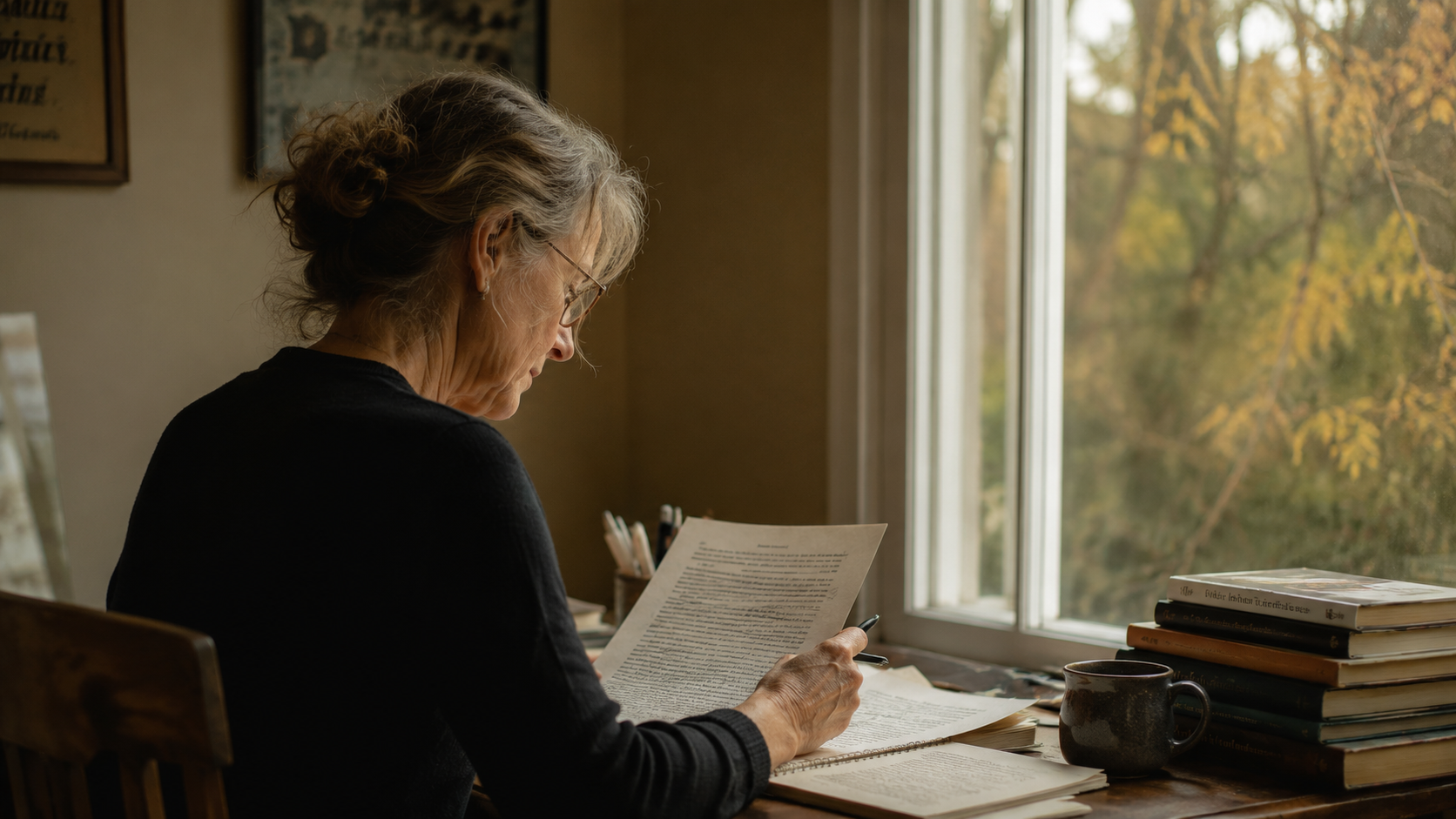
There is a second shift that starts when a writer stops writing for the day.
You close the manuscript. Maybe it went well. Eight hundred words. A chapter finally stopped fighting you. You worked out why a character had been lying to you for three weeks. There's a marked-up page on the desk, a book open beside it, coffee gone cold somewhere.
Then you remember you're also supposed to be building an audience.
So the phone comes out. You need something for Instagram. You haven't posted to Facebook in eleven days. Somebody said authors should be making Reels. TikTok is apparently important unless your readers are elsewhere, in which case it isn't. There's a neglected YouTube account, a Threads profile you opened and forgot, a newsletter you actually own and haven't mentioned since spring. The photo needs a caption. The caption needs shortening in one place and changing in another. Maybe you should look at last week's numbers first.
The writing session is over. The marketing session has begun.
Nobody romanticizes this part, for good reason. And refusing to participate is getting harder to defend. BookBub surveyed more than 850 authors and found over three-quarters using at least one platform every week, with more than nine in ten spending at least a few hours a month making posts. Circana BookScan put BookTok-driven sales at roughly 60 million units in 2024, about twenty percent up on the year before.
None of which means a novelist has to dance on TikTok. It means readers now find books while they're doing something other than shopping for books. That changes what the job is.
Authors get handed the wrong assignment
Most social media advice starts from the assumption that you need to get good at making content. Which is a strange thing to tell a writer.
You already make something. It takes months or years and asks for long stretches of concentration and a tolerance for uncertainty that would drive most people out of the room. The last thing a marketing system should do is start a second creative practice with its own ideas, its own schedule, its own style and its own daily appetite for your attention.
You don't need a second body of work called Content.
You need the first one to leave evidence behind.
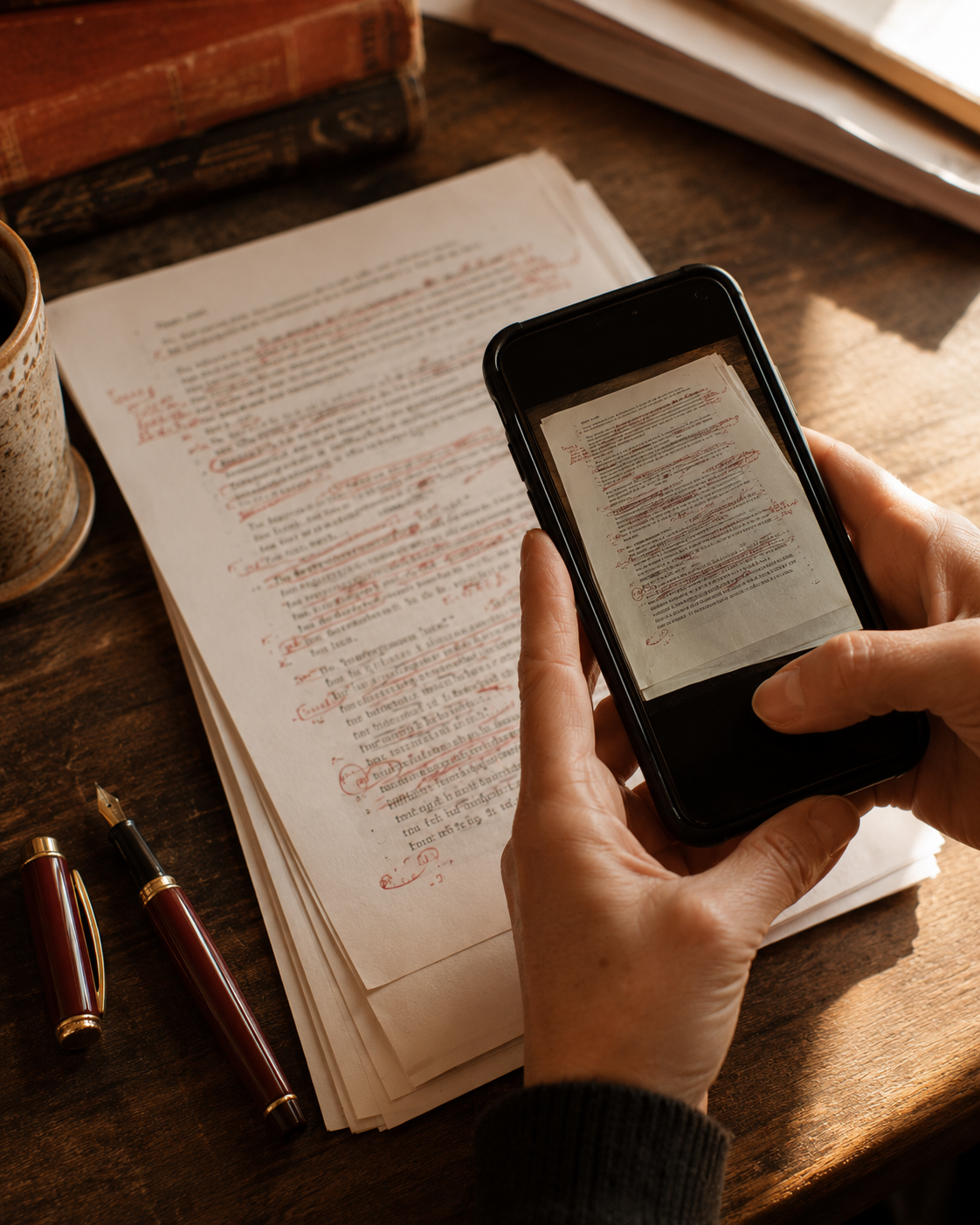
A photograph of a marked manuscript isn't interesting on its own. Neither is a desk, a stack of research books, a proof copy, an empty room before a reading, or coffee you've reheated twice. What makes any of them interesting is what happened.
You cut the scene the whole book once depended on. You spent a morning on a 1912 train timetable because one sentence on page 143 would be wrong without it. The proof arrived and the first thing you saw was a typo. Someone at last night's reading asked a question that made you understand your own character differently. You finally wrote the sentence that lets the chapter end.
That's a writing life, and it happens whether you post about it or not. So the question isn't what you should make for social media today. It's what happened while you were making the book.
The long middle is where readers actually accumulate
Authors think about marketing in bursts. Cover reveal. Preorder. Launch week. The bookstore event, the interview, the review, maybe an award submission. Then it goes quiet and you go back to work, and six months later another book is coming so you surface and start talking again.
Readers never agreed to that schedule.
Someone finds your first novel eleven months after publication. Someone else sees you mentioned by another writer while you're halfway through book two. A third reads an old review, looks up your name, lands on a page that's been quiet since March and quietly decides there's nothing here worth following.
There is no launch week from their side of the screen. There's only the moment they arrive.
This matters because books have long lives. Reading communities have pulled titles back onto bestseller lists years after publication, simply because people started talking about them again. Social media didn't invent word of mouth; it gave word of mouth somewhere to travel.
For one author the lesson is duller than going viral. Stay present. The post about the difficult chapter in February looks unrelated to the October release, and isn't. The research trip, the first proof, the reading in a half-empty room, the reader who noticed the line nobody else mentioned, the start of the next manuscript — together they're continuity. By the time you have something to sell, the people following you aren't reading an advertisement from a stranger. They've been watching the work move. That's a much better place to ask someone to buy a book from.
The dangerous part is opening the app
There's a cost here that doesn't fit in a marketing spreadsheet: to post on a social network you generally have to enter one.
You open Instagram to publish one photograph and see another writer's cover announcement. Then a bestseller screenshot. Then a deal. Then somebody younger than you explaining how they sold twenty thousand copies last month. Fifteen minutes later you know a great deal about other people's careers and have done nothing for your own.
Writers aren't unusually fragile about comparison. They just work in a profession where progress is hard to measure day to day. A manuscript can be better tonight than it was this morning and still have sold exactly the same number of copies, which is none. Somebody else's visible result will always feel more substantial than your invisible progress.
Which is why "spend less time on social media" is simultaneously good advice and infuriating advice for a writer who has also been told to maintain a platform. The useful move is to separate publishing to the feed from standing inside it.
Keep the part that's actually yours
A writer shouldn't outsource the thing readers are interested in.
You know the page covered in pencil matters because the chapter finally works. You decide whether the research trip stays private. You know which rejection is funny now and which one still stings too much to turn into a story. You choose the photograph, the moment, the context, and the line you won't cross. That's authorship in the broad sense: noticing, and deciding what matters.
The machinery around that decision is a different thing entirely.
PostShop doesn't write your novel and doesn't invent a writing life for you. You text UPLOAD, add a photo or clip from the real work to the private page that comes back, and say anything about it we ought to know. We write the caption in your voice, fit it to each platform you've connected, and send it back. You read it. Nothing publishes until you say so.
And on the days when nothing seems worth photographing, you can text IDEA and get three specific things back — not "share something behind the scenes," but the proof copy on the doormat, the three books stacked beside the keyboard, the page you cut. Drawn from what you've already been posting, so it doesn't send you back to the same desk shot every week.
"It'll sound like AI." Say it out loud, because you're a writer
For most businesses this is a convenience question. For you it isn't. Your name is attached to sentences for a living, and a caption that reads like a content farm is worse than silence — it tells a reader something about your prose before they've opened the book.
So the honest version.
The caption is written by a machine. What isn't machine-made is what it's about: a photograph you took, of something that happened, on a day you were actually working. Most AI writing gives itself away not through the sentences but because the post is about nothing — a stock image, an invented milestone, a caption that would fit any author in the genre.
The voice isn't a tone slider either. It starts from how you answered a handful of questions at setup, and where you already have posts of your own we read those. Then it corrects. A draft that isn't right goes back with a note about what to change; we rewrite that one and keep the correction, so it applies to everything after rather than being a fix you have to make twice.
Nobody should promise you the first caption will land. The thing worth watching is whether the third one is closer than the first, and whether the corrections you send stop being necessary.
What it costs, and who it isn't for
$249 a month is not nothing, particularly in a business where plenty of books earn modestly and the same pocket is paying for editing, design, print, ads and travel.
So it shouldn't make sense for everyone who has opened a document and begun chapter one. If you enjoy running your social media, you post consistently already, you like editing video, and time online doesn't eat into the work — you don't need someone to take that job away. If you're not ready to be public about the writing yet, you don't need it either.
It makes sense in a different kind of writing life. You have books out, or one moving toward publication. You intend to keep writing. There's a backlist, a newsletter, events, interviews, research, readings, reviews, a work in progress or a next book already starting. You know staying visible matters, and your actual pattern is good intentions followed by three quiet weeks.
At that point you're not buying captions. You're buying continuity — and the hours you'd have spent formatting, switching accounts and deciding whether this should go on Facebook too.
There's no responsible promise here about selling a particular number of books. Social media doesn't work that cleanly. One post may do nothing. Twenty may appear to do nothing. A reader might watch quietly for six months, join the newsletter on the seventh, buy a paperback on the eighth, and recommend it to somebody you'll never hear about. Readership has always accumulated in ways that are hard to see. The point is to let that accumulation happen without spending the thing the readership was for.
The arrangement is simple
Your writing life produces something worth showing. Show it. Then go back to writing.
The marked page. The research book. The proof on the porch. The hotel room before the conference. Empty chairs before people arrive, full ones afterward. The sentence you cut. The first copy on a bookstore shelf. The manuscript on a morning when it's going badly, and the same manuscript six months later when somehow it exists.
You don't need a persona around any of it. You don't need to turn your private life inside out. You don't need to become an influencer. You need to be findable often enough that the right readers get a chance to run into you, and present long enough that some of them stay.
The book needs the best part of your attention.
The internet only needs proof that you're still writing.
Sources
BookBub Partners, Social Media for Authors in 2025: Data from 850+ Authors
Publishers Weekly, Can Bibliotherapy Drive Book Sales?
Publishers Weekly, How TikTok Makes Backlist Books into Bestsellers
PostShop runs on your real accounts, free for five days. Send one thing you were going to photograph anyway, and see what happens when posting it stops being your job.
Start 5 days free