Where PostShop fits · For presses
A press can launch a book. It can’t stand beside every reader who finishes it.
Small presses survive by helping one another. The readers who finish your books, and the authors who wrote them, will help too, if asking is easy.
Running a small press means doing everything with very little. When the Literary Arts Emergency Fund reported on 410 nonprofit literary organizations and publishers, 76 percent had annual budgets under $250,000 and 74 percent had three paid staff or fewer.1 Anyone who runs a small press, nonprofit or not, will recognize the shape: a list of thirty books and the hours for perhaps three.
The sociologist John Thompson, who spent years interviewing people across publishing, described how small presses get by anyway. Without the overheads of bigger houses, they help one another out: a name for a good designer, advice on distribution. He calls it an economy of favors.2 It is how a three-person press does the work of a thirty-person one.
Where the hours go, and where the readers are
A press gives each book its launch: the catalog copy, the review copies, the distributor, the event. Then the next book needs the same, and the last one goes quiet.
Readers don’t stop, though. Most of the book market is older books: of the 200 bestselling print books of 2024, only about 29 percent were published that year.3 In 2011 Coffee House Press said its backlist provided half its annual book sales income.4 A book’s life after launch is long. A press’s attention can’t be.
What keeps a book selling after launch is what readers do: review it where buyers look, ask their library and their local bookstore to carry it, and pass it to a friend. Reviews change what the next buyer does; Northwestern’s Spiegel Research Center found purchase likelihood is 270 percent higher with five reviews than with none.5 Public library workers name patron requests as the factor they mention most when deciding what to buy.6 Those are steps only a reader can take. A press can’t take them on a reader’s behalf, and the reader who finishes your book three weeks after the book fair is nowhere near you.
The authors on your list
Your authors are the other half of the favor economy. Each has people who would gladly help: a book club, coworkers, family, former students. Most authors don’t know what to ask of them beyond buying a copy, and no press can run thirty authors’ word of mouth for them. That is why many small publishers now look for authors who are willing to help promote their own books.7 What an author needs most is something concrete to send.
What PostShop gives a press
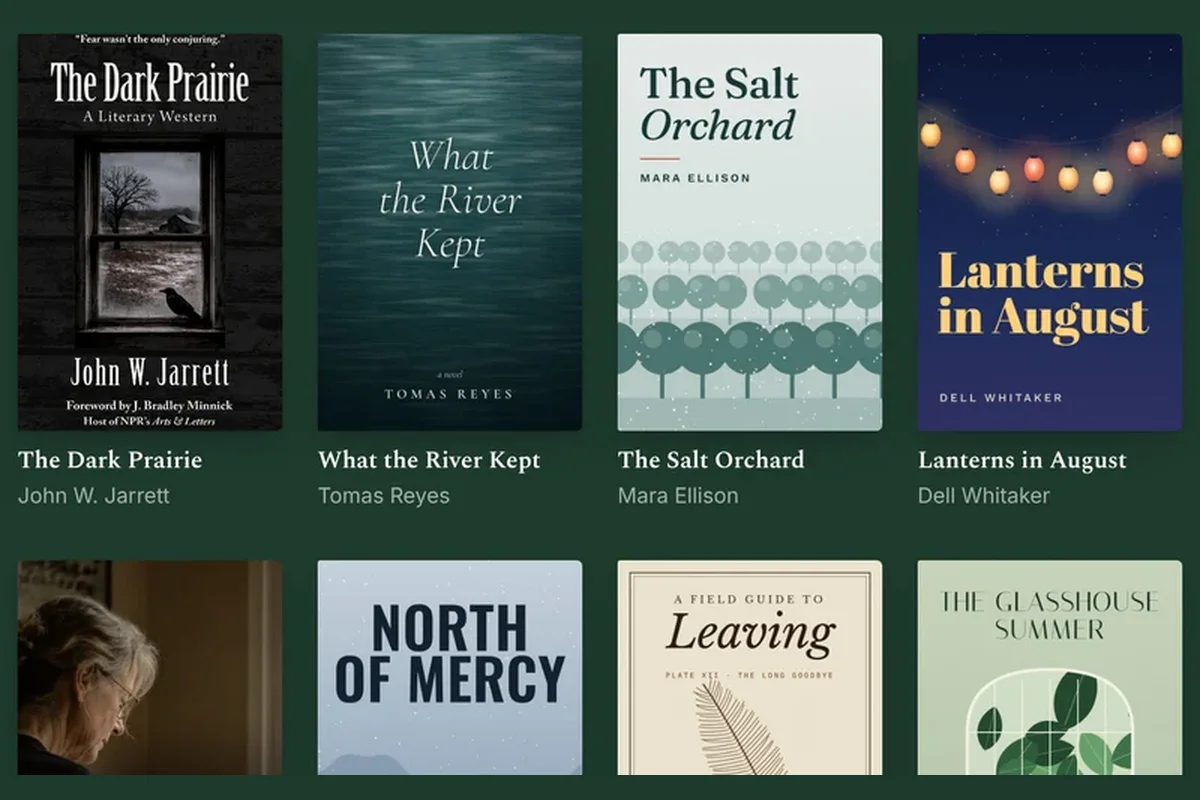
PostShop’s shelf for presses is free for presses with books by at least five authors, for up to 500 books, with no time limit. Upload the list of ISBNs you already keep and every book gets its own reader page and QR code. The whole list gets one shelf page, at postshop.live/shelf/ and your press’s name, with your logo, your colors or a background picture, and a line of your own under your name.
On every reader page, a reader can open each store’s own review form, see the request pages of libraries near them and independent bookstores they can ask to carry the book, set a reminder to review it later, and send the page to a friend in one tap. Library and bookstore requests are for the United States; a reader elsewhere is given the title, author and ISBN to take to their library or bookstore, and reviews work wherever the reader is. From one book, a reader can open your shelf and find the rest of your list. Every library or bookstore a reader asks to carry one of your books, and every time they pass a book’s page on, counts toward a card they can save and share, at 3, then 5, 10 and 25.
Then put the QR codes where readers finish books: the last page of the next printing, a bookmark in every order you ship and every advance copy, the table sign at fairs, a button on each book’s page on your website, your newsletter and your email signature. The same QR codes keep working wherever your books are read, whether or not anyone from the press is there.
And every author on your list can open a reader page of their own for their book, free, with no card. Send each author their book’s page and ask for three things: text it to the readers only they know, their book club, their coworkers, their family; follow up a week later to ask who those people sent it to; and keep finding new groups to send it to. That is the author’s part, and the page makes each step about as small as a step can be.
On the free shelf, your dashboard shows two totals: reader page visits, and library and bookstore requests. Subscribe the press to Relay, the same plan any author has, at $29 a month or $290 a year, and it shows every book’s activity: how many readers tapped through to review it and on which sites, which libraries and bookstores they asked, and a map of where, with a report on the 1st.
Why bother? Honest answers
Start with a question only you can answer. Is your backlist moving at all? If a title has gone quiet, look at what has been put in front of its readers since launch: by the press, and by the author. A book’s reach after launch depends almost entirely on its author, and the press’s job is to make the asking easy. Even the largest trade publisher in the country spends about 2 percent of its revenue on marketing,8 and the authors who earn the most from their books are the ones who give promotion steady time.9
We don’t have time for another system. Upload the list of ISBNs you already keep. We look it over once, and one approval opens your shelf, your reader pages and your QR codes. The reader cards are built in, so there is nothing to run.
Our backlist doesn’t sell anyway. Most of the market is backlist,3 and a press’s backlist can carry half its income.4 A quiet title is usually a title nobody has put in front of a reader lately.
Our authors won’t bother. They don’t need an account to share their book’s page; you send it to them, and they text it on. Ask for three things: send it to their own circles, follow up a week later, and find one new group each month. The page makes each step about as small as a step can be.
Do we need the numbers? The free shelf shows reader page visits and requests in total. Subscribe to Relay and you see which books readers are acting on and which libraries and bookstores they asked, so you know which titles to put on the next fair table and where the next bookmarks should go.
What’s the catch? PostShop is built by Silent Clamor Press, a small literary press. We made these tools to stand up for our own authors, and we want every press to have the same tools for theirs. PostShop is paid by writers who subscribe for their own books, and presses are how many writers first hear of it, so the shelf costs a press nothing, now or later. You can close the account whenever you choose.
A favor economy works best when asking is easy. Give every reader who finishes one of your books a single page with every step on it, and give every author a page their own people can pass on.
PostShop for presses is free for presses with books by at least five authors, for up to 500 books, with no time limit.
References
- Academy of American Poets — on the 2022 Literary Arts Emergency Fund report (with CLMP and the National Book Foundation), 410 organizations and publishers: 76% with budgets under $250,000, 74% with three paid staff or fewer, 80% with no or insufficient cash reserves.
- Poets & Writers — interview with John B. Thompson, author of Merchants of Culture, on the economy of favors among small presses.
- Literary Hub — citing Publishers Lunch: about 29% of the 200 bestselling print books of 2024 were published that year; the rest were backlist.
- HuffPost — interview with Allan Kornblum and the Coffee House Press staff, 2011: a backlist that provides half the press’s annual book sales income.
- Spiegel Research Center, Northwestern University — “How Online Reviews Influence Sales”: purchase likelihood for a product with five reviews is 270% greater than for one with none.
- Jessica Hilburn, Information Today — “The Complex Role of Demand-Driven Acquisition in Public Libraries: A Survey,” October 2022: patron requests, recommendations or demand were the purchasing factor mentioned most often.
- IBPA Independent — “Collective Engagement: Authors and Publishers Marketing Together,” March/April 2019: publishers expect authors to help market their books, and some look for authors willing to.
- Publishers Lunch — The Trial: The DOJ’s Suit to Block Penguin Random House’s Acquisition of Simon & Schuster, 2022: the largest trade publisher spends about 2% of revenue on marketing.
- BookBub Partners — “What Does a Writer Do?” author survey: more than 70% of authors grossing $10,000 or more a month spend six or more hours a week on marketing; about 40% of authors earning less do.
Figures are cited as published by their sources. Where a source has updated its numbers since, the source is authoritative and this page is not.