Where PostShop fits · For writing programs
Every book your writers publish is evidence. Most of it is sitting in a list.
An alumni list shows a writing program works. A shelf where readers can review and request those books keeps them in circulation too.
There are a lot of writing programs, and a lot of graduates. Literary Hub counted 244 MFA programs in 2016, up from 156 in 2008, and estimated 3,000 new MFA graduates in the United States each year.1 Every one of those writing programs hears the same question from prospective students: what happens to the writers who come here?
The answer is usually a page. Look up a writing program’s alumni books and you will find lists kept by hand: titles, publishers, years, sometimes covers. Saint Mary’s College of California says more than 380 students have earned its MFA and that its alumni have published more than 80 books.2 West Virginia University’s list of books by its creative writing alumni asks any graduate with a book not listed to get in touch.3 Someone in the department keeps it up, when they can.
Those pages do a real job. They are also where a reader’s path ends. A reader who finds an alum’s novel on a list has to leave, look for it somewhere else, and decide what to do. And the poets and story writers who publish in journals long before they have a book often aren’t on the list at all.
What a shelf adds
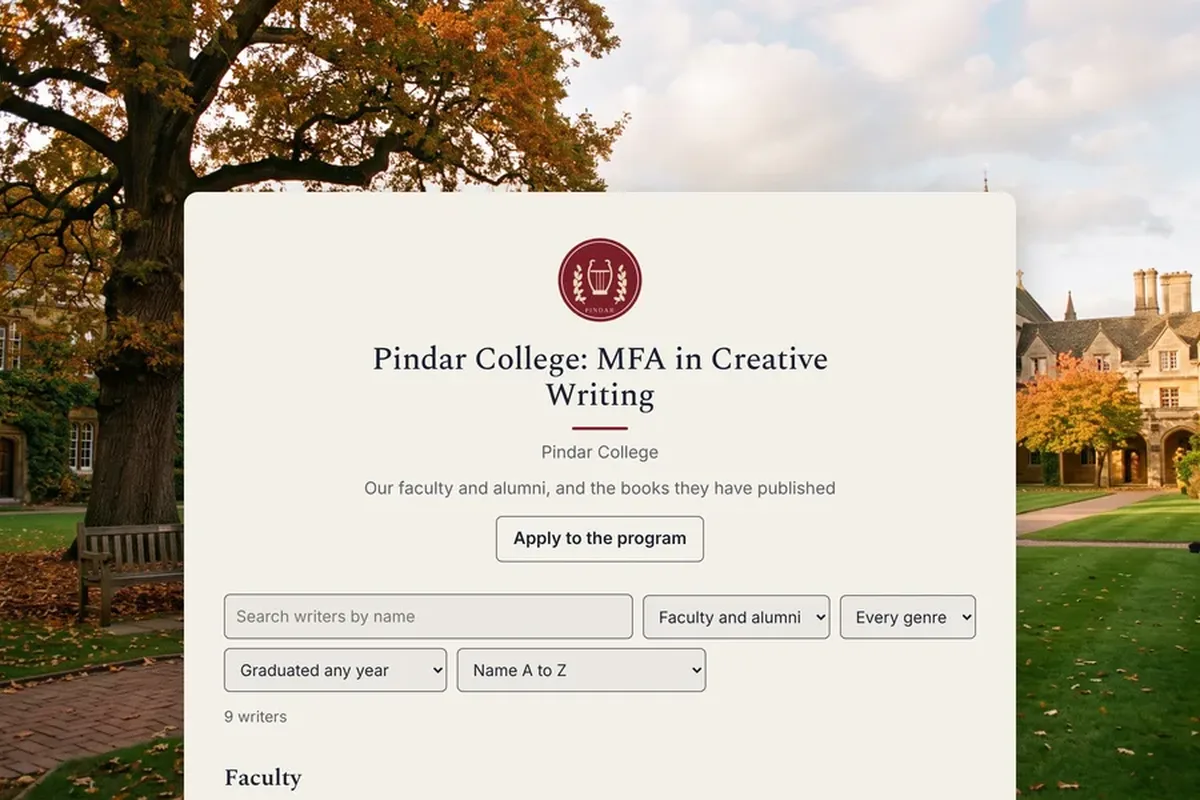
PostShop gives writing programs a free shelf: your faculty and alumni, each with a short bio, their books, and the stories, poems and essays they’ve published in journals. Faculty and alumni are searchable by name and sorted by graduation year. Headshots are off unless you turn them on and upload photos you have the right to use; otherwise each writer has a card with their initials.
Every book opens to a reader page where a reader can review it on the sites they use, or ask their library or bookstore to carry it. Each journal piece links to the journal’s own page for it. A writer with journal publications and no book yet still has a page on your shelf.
That turns a list of accomplishments into something that keeps books in circulation. The novel an alum published eight years ago gets a page where a new reader can ask their library to carry it. Prospective students see what your writers publish, and every visitor who reads a writer’s bio is one step from doing something about that writer’s book.
What it asks of you
Writing programs don’t have spare staff hours, so the shelf asks for very little. Send one spreadsheet, with a row for each book, story, poem or essay. For a book, the writer’s name, its ISBN and its title: the ISBN makes a sure match and the title confirms it. For a journal piece, its title, the journal’s name and the link. If you keep a publications page, give its address and PostShop reads the books from that page. Each writer’s short bio is the one you put in the sheet or type on your dashboard.
If an ISBN can’t be matched, your dashboard shows which row and why, such as a likely typo. PostShop never adds a book by searching for a writer’s name; only the writers and books you list appear, and no one else can add a writer.
After that, your writers can keep their own pages up to date. From a free PostShop account, a writer you’ve listed can add their stories, poems and essays, their other books, their bio and their website. You are told by email and can take anything off. Add new alumni from the dashboard or by uploading the spreadsheet again, which never removes anyone.
Link to the shelf, or place it on one of your own pages with a few lines of embed code. Your dashboard shows page views for the shelf and for each writer’s page, so you see which writers draw the most attention. Nothing about visitors is kept. Reviews, library and bookstore requests and readers’ messages belong to the writers.
Built for a university’s web rules
Public universities now work under a federal accessibility rule. In 2024 the Department of Justice adopted WCAG 2.1 Level AA as the technical standard for the websites and apps of state and local government entities under Title II of the ADA, public universities included.4 In April 2026 it moved the compliance dates back a year, to April 26, 2027 for larger public entities and April 26, 2028 for smaller ones, without changing the standard.5 Writing program shelves are built to WCAG 2.1 Level AA and tested against it in light and dark mode before they ship. The embed runs no scripts on your page, sets no cookies and loads no trackers, and there is an accessibility conformance report for your web team.
Why bother? Honest answers
Start with a question only you can answer. When a prospective student reads your alumni-books page, what can they do next? If the answer is nothing, the page is a record, not a place where your writers’ books are read.
We already have an alumni page. Keep it. Place the shelf on it with a few lines of embed code, or link to it, and every book on it gains a page where a reader can review it or ask their library to carry it.
We don’t have the staff time. Send one spreadsheet, or the address of the publications page you already keep. After that, your writers can keep their own pages up to date, and uploading the sheet again never removes anyone.
Our web team won’t approve another vendor. The shelf is built to WCAG 2.1 Level AA, the embed runs no scripts on your page, sets no cookies and loads no trackers, and your web team gets an accessibility conformance report and a page written for them.
What about our writers’ privacy? Only the writers and books you list appear, and no one else can add a writer. Headshots are off unless you turn them on. Nothing about visitors is kept.
Do page views matter? They show which writers draw attention: the names to feature in recruiting, alumni news and readings.
What’s the catch? PostShop earns when writers choose to use PostShop for their own books, so a shelf costs a writing program nothing.
Your writers’ books are the best evidence a writing program has. Put them where readers can do something about them.
PostShop for writing programs is free, with no fees and no contract, and built to WCAG 2.1 Level AA.
References
- Literary Hub — “MFA by the Numbers, on the Eve of AWP,” 2017: 156 MFA programs in 2008, 244 in 2016; an estimated 3,000 new MFA graduates in the United States each year.
- Saint Mary’s College of California — MFA in Creative Writing, Alumni.
- West Virginia University, Department of English — Books by Creative Writing Alumni.
- U.S. Department of Justice, ADA.gov — the 2024 ADA Title II rule on web content and mobile app accessibility, adopting WCAG 2.1 Level AA.
- Federal Register — Interim Final Rule, April 20, 2026: compliance dates extended to April 26, 2027 (total population 50,000 or more) and April 26, 2028 (smaller entities and special districts).
Figures are cited as published by their sources. Where a source has updated its numbers since, the source is authoritative and this page is not.