
Nobody joined social media because they wanted content.
They wanted to see somebody.
- A friend moved across the country.
- Your cousin had a baby.
- Someone opened a restaurant.
- A guy you went to high school with bought an unreasonable boat.
- A mechanic pulled something out of an engine that absolutely should not have looked like that.
That was the appeal. Something happened in somebody else’s life, and now you got to see it. That was a pretty good promise.
Then we got very good at social media, and somehow made it worse.
Sharing became performing.
The platforms gave us numbers. Likes, shares, views, followers, watch time, engagement. Then the algorithms got better at working out what kept people looking, and people learned too. Certain things got attention, so we made more of those things.
Businesses did the same. Somewhere along the way, the guy rebuilding transmissions was informed that he was also the publisher of a small media company and needed a content calendar for Thursday.
Nobody really stopped to ask why. So businesses started filling slots. Five tips. Three mistakes. Monday motivation. National Whatever Day. A stock photograph. A graphic. A Reel, because apparently we’re doing Reels now.
The original question
What happened today that somebody might want to see?
What it became
What can we manufacture today that might get somebody to look?
Those are very different questions.
The “dopamine hit” explanation is a little too easy.
You will often hear social media explained as a machine for delivering dopamine hits. There is real science underneath the broader idea that social feedback rewards behaviour, but reducing the whole thing to dopamine is too neat.
A 2021 study in Nature Communications analysed more than a million social-media posts from over 4,000 people across several platforms. Posting behaviour followed patterns predicted by reward-learning theory: people adjusted how often they posted in relation to the social rewards they received. In a separate experiment, the researchers manipulated the number of likes participants got, and those rewards changed subsequent posting behaviour.1
Other research helps explain why likes matter at all. In an fMRI study simulating Instagram, adolescents were more likely to like photographs that already appeared popular — and seeing photographs with many likes was associated with greater activity in brain regions involved in reward processing, attention and social cognition.2
So the interesting point isn’t that phones inject dopamine into your brain. It’s simpler than that.
We learn what gets rewarded.
And then, often without thinking much about it, we do more of it.
The system can change what gets expressed.
This isn’t only about how often somebody posts. It can affect what people choose to say.
Researchers at Yale analysed 12.7 million tweets from more than 7,000 users and ran controlled behavioural experiments on expressions of moral outrage online. When outrage received more positive social feedback — likes and shares — users became more likely to express outrage again. People also adjusted their behaviour toward the norms they observed in their own networks.3
That doesn’t mean every angry post exists because an algorithm made somebody angry. It means something more important.
The environment rewards certain behaviour, and people learn from those rewards.
Now imagine that mechanism operating billions of times.

This is where the design matters.
Infinite scroll. Autoplay. Visible like counts. Personalised recommendations. Notifications bringing you back.
None of those things proves social media is inherently evil. But they aren’t meaningless design decisions either. The U.S. Surgeon General’s 2026 advisory on screen use calls on platforms to eliminate features designed to maximise screen time, naming autoplay video, infinite scroll, recommendation algorithms and reward notifications, particularly where children and adolescents are concerned.4
And there is legitimate reason for concern about excessive or problematic use. A systematic review and meta-analysis of 18 studies involving more than 9,000 adolescents and young adults found statistically significant associations between problematic social-media use and symptoms of depression, anxiety and stress.5
That finding needs an important qualifier. Association is not the same thing as proving social media caused those conditions. A much larger 2024 review covering 143 studies and more than a million adolescents likewise found positive associations between measures of social-media use and internalising symptoms, while emphasising how much the results depend on how social media is being used and measured.6
That last part is the part worth keeping. The technology isn’t one experience.
- Talking to a friend isn’t the same thing as doomscrolling.
- Looking at pictures of your grandson isn’t the same thing as chasing likes from strangers.
- Watching a technician explain a failed wheel bearing isn’t the same thing as being fed outrage for two hours.
How the tool is used matters.
We built machines that got extremely good at getting attention.
That created an obvious incentive. If the scoreboard says ENGAGEMENT, people eventually start playing for engagement.
Outrage gets engagement. So does novelty, fear, beautiful things, terrible things and certainty.
A 2026 paper in the Journal of Public Economics modelled the feedback loop between engagement-based ranking algorithms and user behaviour. It found a fundamental trade-off: assigning greater weight to social interactions such as likes and shares increases engagement while also increasing misinformation and polarisation in the model.7
That does not mean an algorithm sits in a room plotting to make people miserable. It doesn’t need to. If you optimise a system for one thing hard enough, you should not be shocked when you get more of that thing.
And a guy calmly doing competent work on a Tuesday afternoon may not win an engagement contest. But competent work on a Tuesday afternoon may be exactly what you needed to see before deciding who should fix your car.
This is where business social media went wrong.
The mistake wasn’t that businesses started using Facebook or Instagram. They should. Those platforms give a business something extraordinarily valuable: the ability to let thousands of people look inside a place they would otherwise never enter.
The mistake was deciding the business had to become a content producer to deserve that attention.
Think about an auto repair shop. The shop already has things worth showing.
- A difficult diagnosis.
- A failed part.
- A technician who caught something unusual.
- A customer who was told she needed a $4,000 repair and actually needed something completely different.
- A young technician learning from somebody with twenty years of experience.
- A car everybody in the building stopped to look at.
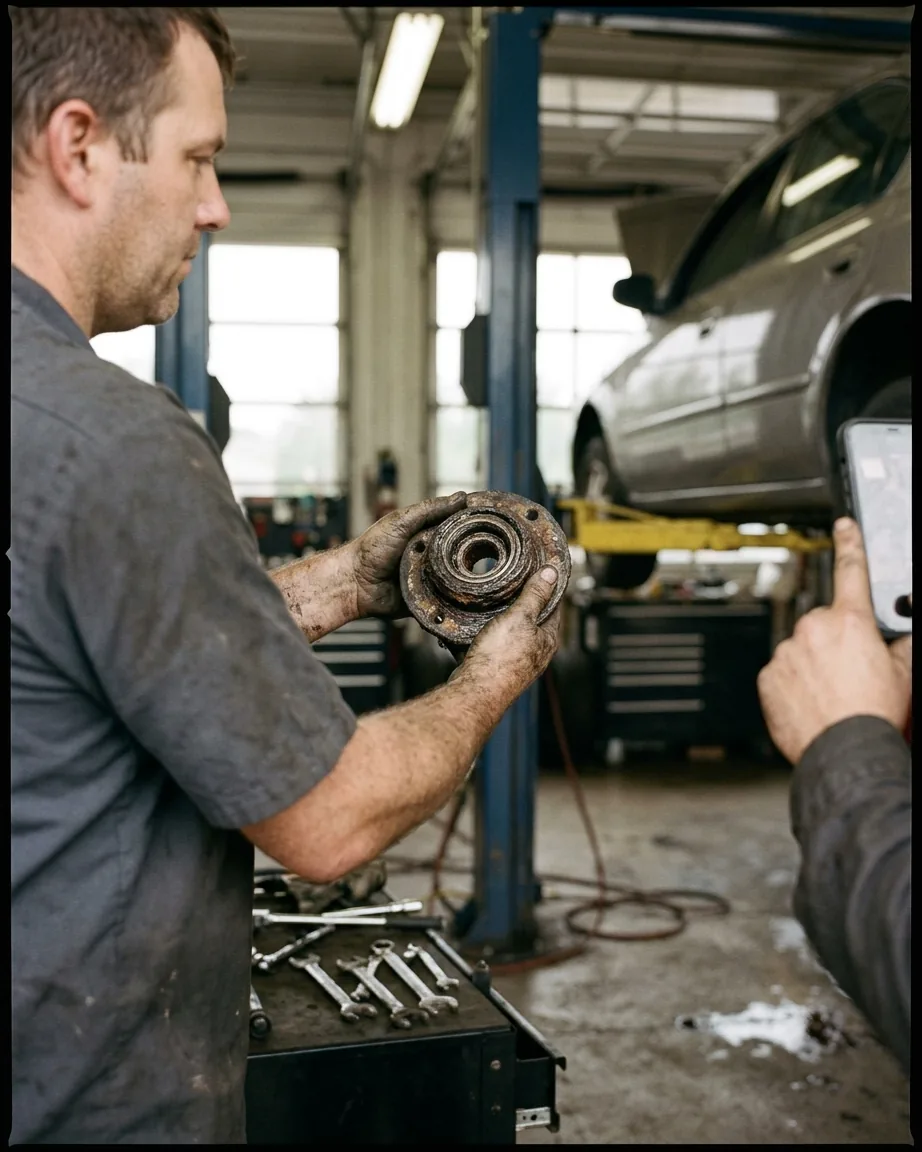
It doesn’t need a dancing mechanic pointing at floating words. It needs a camera.
Then AI arrived, and everybody blamed the new guy.
AI did not create meaningless content. We were doing a perfectly respectable job of that ourselves. AI simply made it possible to produce meaningless content much faster.
If your goal is to fill thirty spaces on a calendar, AI is magnificent. It will never get tired. Need another post about why people should check their tyre pressure? Done. Another inspirational quote? Done. “Five signs your alternator may be failing”? Apparently civilisation was waiting for number four.
AI can produce an effectively unlimited amount of material. The problem isn’t the intelligence.
It’s the assignment.
Tell a machine to make you more stuff and you get more stuff. Tell it to help you communicate something real that happened, and that is a completely different use of the same technology.
AI isn’t the villain. But it isn’t magic pixie dust either.
Saying “AI is bad” is too simple. So is saying technology has no consequences because it’s “just a tool.”
Tools are designed. They are given objectives. They operate inside systems. People decide when they should act and when they shouldn’t. People decide whether their output gets reviewed. People decide what happens when they’re wrong.
The National Institute of Standards and Technology’s AI Risk Management Framework treats those questions as fundamental to responsible AI, recommending that the responsibilities of humans and AI systems be clearly defined, and noting that some applications should require human oversight.8
That is a much more useful question than whether AI is morally good or bad. Ask what job you gave it. And ask who is responsible for the result.
We think AI should do the part that isn’t you.
This is the line PostShop draws. A real thing happens first. A person sees it. A person takes the photograph or records the video. That is the source.
AI can do an enormous amount after that. Write the caption. Adapt it for different platforms. Crop the image. Create different versions. Translate it. Handle the repetitive production. Add subtitles. Turn a recorded explanation into something readable. Look at what has been working and suggest another real thing worth photographing.
What it should not do is invent the life of the business because the calendar says Thursday needs a post.
AI can do the production work. It doesn’t get to invent your day.
And it doesn’t get the final word.
This matters just as much. When PostShop writes something, the owner sees it. Read it. Change it. Reject it. Approve it. Nothing publishes until a person decides yes, that’s what I want to say.
The same principle applies when someone comments. AI can prepare a reply; a human approves it before it speaks under the business’s name.
That introduces a little friction. Good. Some friction is useful. The few seconds required to read something before attaching your name to it may be one of the healthier uses of technology we have come up with.
The goal isn’t to remove the person. It’s to remove the drudgery around the person.
That is the whole design. Something happens in your business, you send it, you approve what comes back, and PostShop handles the writing, the platform versions, the publishing and everything after.
Start 5 days free$199/month, everything included · 5 days free before you’re charged · Cancel anytime
Maybe social media doesn’t need to be reinvented.
Maybe we just need to give it its old job back.
- Show me what happened.
- Show me what you learned.
- Show me what you’re making.
- Show me the person doing it.
- Show me the mistake.
- Show me the repair.
- Show me something I wouldn’t have known if you hadn’t been there to see it.
Then use every useful piece of technology available to make sharing that moment easier. Including AI.
Because there is an irony here. AI is often accused of making social media less human, and it certainly can. But used differently, AI can remove enough writing, editing, formatting, resizing, scheduling and repetitive work that the actual human no longer has to spend his afternoon pretending to be a content department.
He can go back to doing the thing worth showing.
That is the version of social media we want.
Not a world without algorithms. Not a world without AI. Not a nostalgic attempt to recreate Facebook in 2007. And definitely not a world in which every mechanic has to become an influencer.
Just a better division of labour.
- The human supplies the life.
- The machine handles the repetition.
- The human keeps the judgment.

Something happens. Take the picture. Let the technology help. Read what it gives you. Change it if you want. Approve it. Then go back to your day.
Someone on the other side gets to see something real that happened in another person’s world.
Which, come to think of it, sounds an awful lot like what social media was supposed to be.
References
- Lindström, B., Bellander, M., Schultner, D. T., et al. “A computational reward learning account of social media engagement.” Nature Communications, 12, 1311 (2021). doi:10.1038/s41467-020-19607-x.
- Sherman, L. E., Payton, A. A., Hernandez, L. M., Greenfield, P. M., & Dapretto, M. “The Power of the Like in Adolescence: Effects of Peer Influence on Neural and Behavioral Responses to Social Media.” Psychological Science, 27(7), 1027–1035 (2016). doi:10.1177/0956797616645673.
- Brady, W. J., McLoughlin, K., Doan, T. N., & Crockett, M. J. “How social learning amplifies moral outrage expression in online social networks.” Science Advances, 7(33), eabe5641 (2021). doi:10.1126/sciadv.abe5641.
- Office of the U.S. Surgeon General. Surgeon General’s Warning on the Harms of Screen Use: An Advisory and Toolkit on How to Protect Children and Youth (U.S. Department of Health and Human Services, released 20 May 2026).
- Shannon, H., Bush, K., Villeneuve, P. J., Hellemans, K. G. C., & Guimond, S. “Problematic Social Media Use in Adolescents and Young Adults: Systematic Review and Meta-analysis.” JMIR Mental Health, 9(4), e33450 (2022). doi:10.2196/33450.
- Fassi, L., Thomas, K., Parry, D. A., Leyland-Craggs, A., Ford, T. J., & Orben, A. “Social Media Use and Internalizing Symptoms in Clinical and Community Adolescent Samples: A Systematic Review and Meta-Analysis.” JAMA Pediatrics, 178(8), 814–822 (2024). doi:10.1001/jamapediatrics.2024.2078.
- Germano, F., Gómez, V., & Sobbrio, F. “Ranking for engagement: How social media algorithms fuel misinformation and polarization.” Journal of Public Economics, 255, 105589 (2026). doi:10.1016/j.jpubeco.2026.105589.
- National Institute of Standards and Technology. Artificial Intelligence Risk Management Framework (AI RMF 1.0), NIST AI 100-1 (2023), Appendix C: Human-AI Configuration.