A Few Hundred Readers · Part IX
Documentation Is Not Promotion
You became a writer to work in private, through the page. Good news: nothing this series asked of you was ever self-promotion — and the private writer does this better than the performer.
There’s a kind of writer who reads everything I’ve written in this series, agrees with all of it, and still won’t do any of it. Not from laziness, and not really from fear of the work. From distaste. Because somewhere underneath the practical objections is a truer one: I became a writer precisely so I wouldn’t have to do this. To speak through the page instead of the self. To stay out of the spotlight, not stand in it.
If that’s you, I want to start by saying the resistance is not a flaw to muscle past. It’s information, and it’s mostly pointing at something real. It’s just aimed at the wrong target.
Two words for what you think you’ve been asked to do
You believe you’ve been asked to self-promote and to perform. You recoil at both, and you’re right to — they’re genuinely a little gross, and they’re the opposite of the temperament that made you a writer.
But neither is what any of this was. They’re misnamings, and once you separate them from what you were actually asked to do, most of the distaste drains away.
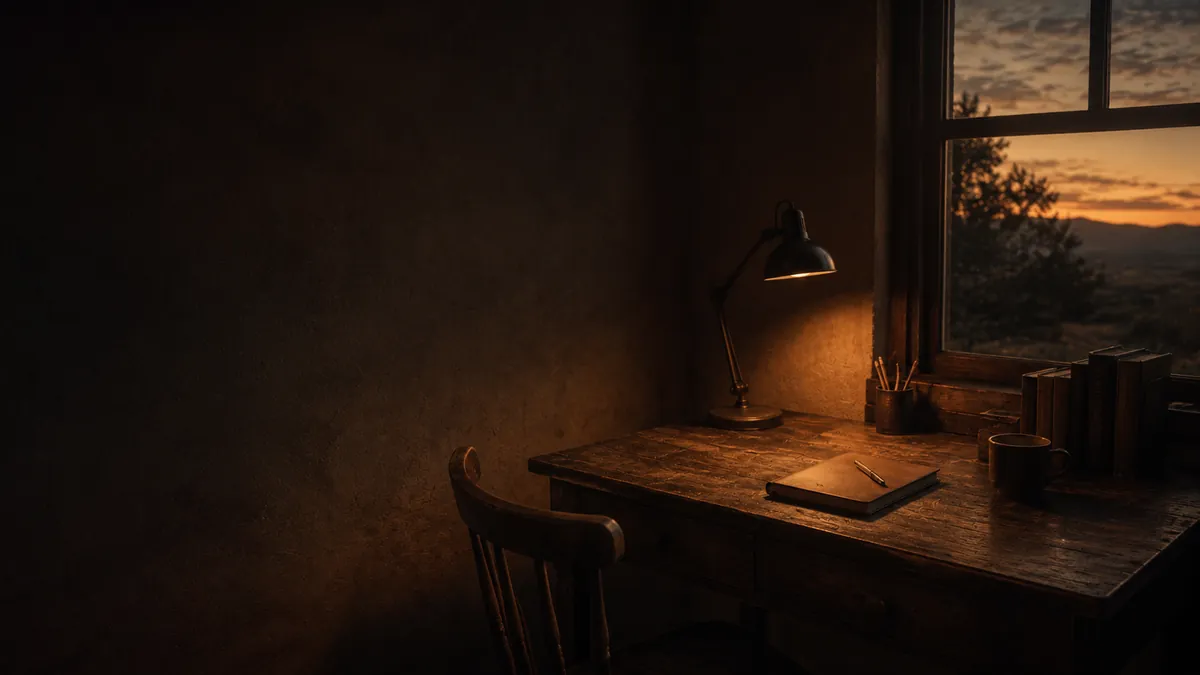
Promotion sells. Documentation testifies.
Promotion says buy this, look at me, aren’t I impressive. It’s an ask, pointed at a stranger’s wallet, and if the thought of it makes you wince, keep wincing — that instinct is good.
But the whole method in these essays was never that. The coffee and the marked page and the line about what the chapter cost you — that’s not a sales pitch. It’s a record. It says this happened; here is the work; here is one true thing about today. It testifies; it doesn’t sell. You are not standing on a corner shouting about your book. You are leaving an honest account of a life spent making something, and letting the people who care find it.
That’s documentation, and you do it already — it’s most of what fiction is.
Performance puts on a self. Honesty takes one off.
The second fear is that you’ll have to perform — become charismatic, funny, a personality, a brand. That you’ll have to manufacture a self for an audience.
But the entire method runs on the exact opposite of performance. Its whole currency is the unperformed moment: the ordinary desk, the real doubt, the plain true sentence. The platforms themselves have tilted toward this — what gets rewarded now is the raw and the human, not the polished and produced. Which means the performer is actually at a disadvantage here, and the private, unshowy writer is built for it. Readers can smell a performance. They lean toward the person who isn’t giving one.
You were worried you’d have to become someone else to do this. The truth is the reverse: the more like your actual, quiet, unperforming self you are, the better it works.
“But it feels like bragging.”
It would, if you were posting trophies. But documentation isn’t the trophy — it’s the work, failures included. I cut my favorite paragraph this morning and it hurt. Third pass and I still don’t trust the first line. I have no idea if this is any good. No one hears those as bragging, because they aren’t. Bragging shows the win. Witness shows the labor, the doubt, the cost. You can be allergic to self-congratulation and still tell the truth about a hard day at the desk — in fact, that allergy is what will keep your record honest.
“I don’t want to be a brand.”
Then don’t be one. A brand is a performed, managed, consistent persona — a self engineered for an audience. The series never asked for that. It asked for a record kept by a real person. A writer documenting honestly isn’t a brand; they’re just a human being, visible. You can keep every bit of your privacy that matters and still leave the door open a crack.
You can do all of this as exactly who you are
Here is the permission, plainly. You never have to show your face. You never have to be witty. You never have to sell anyone anything. You only have to tell the truth about the work — which is the one thing you were always good at, the thing that made you a writer in the first place.
The reluctance was right about one thing: don’t become a performer, don’t become a salesman. It was just wrong about what was on offer. You don’t have to. Keep your privacy. Keep your reluctance, even. Just leave the record — quietly, in your own unperformed voice — and let the people who’d love the work find their way to it.
That isn’t self-promotion. It’s witness. And witness is something a private person can do better than anyone.
Next: the comparison machine — why the same feed you post to is engineered to make you feel behind, and how to keep other writers’ wins from poisoning your work.
PostShop Complete publishes your own words exactly as you typed them — not polished, not rewritten. Every post waits for you before it goes anywhere: approve it, change it, send it back, or drop it.
PostShop Complete: $99 a month for everything in Relay, and your social media kept up from what you send. Five days free, cancel anytime. See PostShop Complete · Everything included.