Where PostShop fits · For published authors
You don’t have a marketing budget. You have people who believe in you.
No ad budget will outspend the publishers. The readers who already love your book, and the people who love you, are the advantage you have.
Launch week ends. The posts slow down, the congratulations fade, and the book is now one of thousands that came out the same month. That quiet is not a verdict on the writing. It is arithmetic.
The arithmetic
Bowker counted about 3.2 million new titles with ISBNs in the United States in 2023: about 563,000 from traditional publishers and about 2.6 million self-published.1 That is close to 8,800 a day.
Most of them sell modestly. When Circana BookScan’s analyst Kristen McLean looked at the 45,571 new print titles the largest publishers had released over a year, 0.4 percent sold 100,000 copies or more, and about two-thirds sold fewer than 1,000.2 Those are books with a major publisher’s distribution behind them.
The money follows the copies. The Authors Guild’s 2023 survey of 5,699 published authors found a median book income of $2,000 for 2022. Its chief executive, Mary Rasenberger, said the survey “paints a sobering picture of the financial realities authors face today.”3
So most writers face the flood the same way: no ad budget, no publicist after the first month, and a day job.
What moves a book anyway
The good news is in what readers respond to, and none of it costs money.
Reviews. A book page with reviews is a different page. Northwestern’s Spiegel Research Center found that the purchase likelihood for a product with five reviews is 270 percent greater than for one with none.4 Most readers who love a book mean to review it. Few reach the store’s review form, several taps deep, before the moment passes.
Library requests. Libraries listen to their cardholders. In a 2022 survey of public library workers, patron requests were the factor mentioned most often in what they buy.5 But the request has to come from someone with a card at that library, on a form somewhere on its website.
Bookstore requests. Independent booksellers say much the same about their shelves. Answering an author on Publishers Weekly’s ShelfTalker blog, one bookseller put demand first, “based on customer requests, bestseller lists, what’s in the media.”6
Word of mouth. Readers trust the people they know: in Nielsen’s 2021 survey of more than 40,000 people, recommendations from people they know were the most trusted source of all, at 88 percent,7 and “people I know personally” was the top source of book discovery in a 2025 survey of readers on Everand and Fable.8
Every one of those is something a reader does, not something an author can buy. The author’s part is putting the right step in front of the right person at the right moment.
The people who support you
Here is the advantage most authors underuse. You already have people who want your book to do well: your partner, your sister, the friend who tells everyone she knows a real novelist, your former students, the book club that read it first. They ask how the book is doing. They would help if they knew how.
Usually helping means buying a copy, and they already did. What they can’t easily do is hand your book to the readers they meet, with every step ready: the review buttons, the library request, the bookstore down the street.
The part only you can do
None of this starts without you. Publishers know it: many now look for authors who are willing to help promote their own books.9 And the authors who earn the most from their books give promotion steady time. In BookBub’s survey of authors, more than 70 percent of those grossing $10,000 or more a month spend six or more hours a week on marketing; among everyone else, about 40 percent do.10
Relay doesn’t ask for six hours a week. It asks for three things, and they are yours:
- Send it. Text your book’s page to the people who have read it or said they would: five today, five more next week.
- Follow up. A week later, ask each of them who they sent it to, and whether that person has read it yet. Most people mean to pass a link on and then forget. A friendly reminder from you is usually what turns “I’ll send it to my sister” into a sent link.
- Find the next place. A book club that meets at your library, your alumni newsletter, a coworker’s reading group, the person at a party who asked what your book is about. Every new group is a new start.
That is all PostShop needs from you. It makes each step about as small as a step can be. The step is still yours.
What Relay does
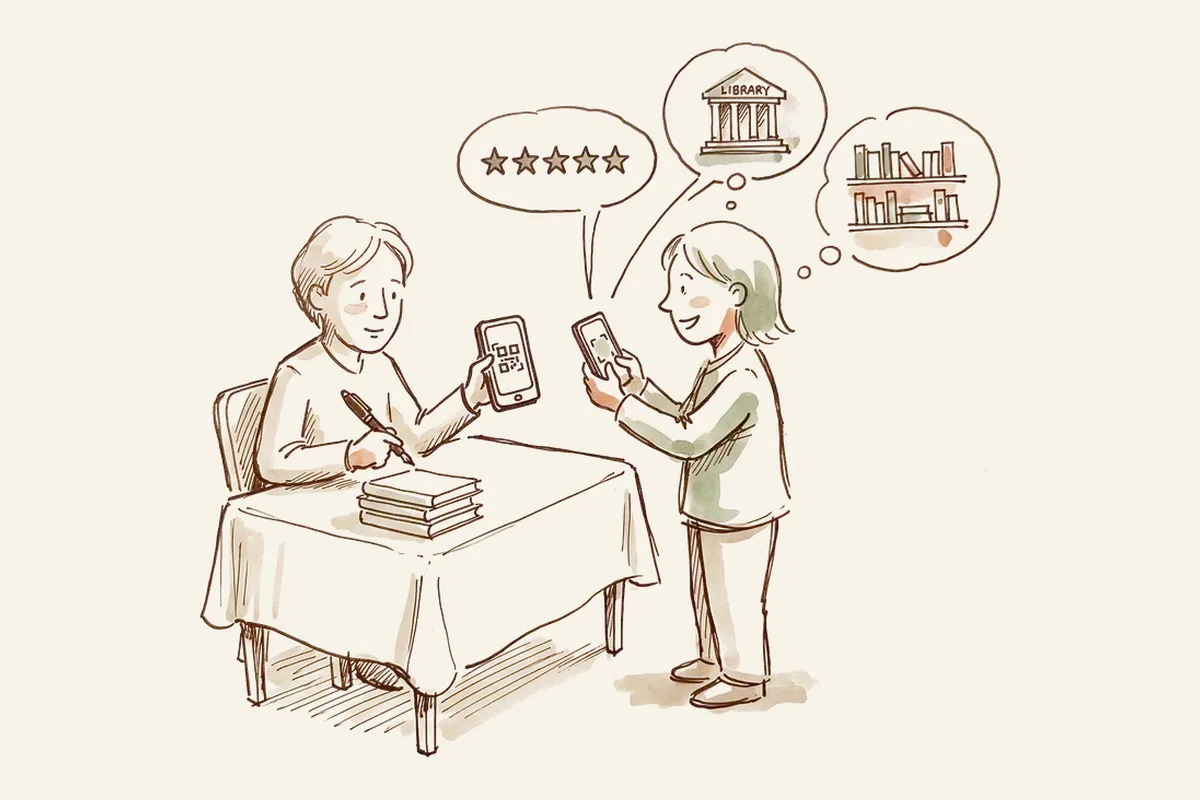
PostShop Relay gives each of your books a reader page and a QR code. When a reader tells you they finished your book, you show the QR code on your phone, they point their own camera at it, and the reader page opens on their phone. From there:
- a button for each store opens that store’s own review form, on Amazon, Goodreads and Barnes & Noble;
- they enter a ZIP code and see the request pages of libraries near them, and independent bookstores they can ask to carry your book;
- if they haven’t finished it, they set a reminder;
- and in one tap they can send the page to a friend who would like it.
Library and bookstore requests are for the United States; reviews work wherever your readers are. You also get a printable table sign and bookmarks with the same QR code, and the page goes by text or any message app to the readers who aren’t in the room.
On paid Relay, the people who support you carry it too. Add your partner, your sister or the friend who has read it twice to your account, from your dashboard or by texting ADD and their number to your PostShop number, and your book’s QR code is on their phone, in front of everyone they meet. They share it rather than reviewing it themselves. Each reader they reach can pass it on again.
Relay is free for one book: its reader page, QR code, sign and bookmarks, with no card. Paid Relay, $29 a month or $290 a year, covers all your books and adds a number of your own to text, the family and friends you add to your account, reader reminders, the names of the libraries and bookstores readers asked, a map of where readers are, a field note on the 15th with one next step, and a report on the 1st. Paid Relay Ready is included, for the next book before it has an ISBN.
Before launch, or years after
Relay doesn’t mind how old the book is. Set it up before publication and your advance readers can review it on Goodreads straight away, while anyone they send it to can pre-order the book from the same page; on launch day the Amazon and Barnes & Noble buttons appear by themselves.
And older books are where most of the market is. Only about 29 percent of the 200 bestselling print books of 2024 were published that year.11 For the book you published ten years ago, Relay is a second launch, built on the readers who still remember it.
Between books
The quiet after launch is also the stretch where most writers disappear until the next book, and then launch it to no one. PostShop Complete, at $99 a month, includes everything in Relay and keeps your social accounts going from what you send: a photograph and a line from your phone, turned into posts for every account you connect, including short vertical video for TikTok and YouTube, where readers who don’t know you yet find writers. It is built for writers who would rather not be on social media at all, so it actually gets done, and each month’s report shows what is working and what to lean into. The next book launches to people who already know your name.
Why bother? Honest answers
Start with a question only you can answer. Is your book moving at all? If it isn’t, look first at your own investment in its success before you blame the market, the cover or your publisher. Count the people you have personally handed it to in the last month. Here is the cold truth: a book’s reach depends almost entirely on its author. If you bring no energy or interest to it, don’t be surprised when it goes nowhere.
Don’t take our word for it. The numbers point the same way from every side:
- Publishers spend little on marketing. Testimony at the 2022 antitrust trial over Penguin Random House’s bid for Simon & Schuster showed that the largest trade publisher in the country spends about 2 percent of its revenue on marketing.12 Spread across thousands of new titles a year, that is very little for any one book.
- Publishers expect you to carry it. Many now look for authors who are willing to help promote their own books.9
- The authors who earn are the ones who do the work. In BookBub’s survey, more than 70 percent of authors grossing $10,000 or more a month spend six or more hours a week on marketing, against about 40 percent of everyone else.10 In Written Word Media’s 2025 survey of indie authors, 44 percent earned $100 a month or less, and many of them spend little or nothing on marketing; the authors earning over $1,000 a month almost always have an email list and regular marketing spend.13 The Authors Guild credits effective marketing for experienced self-published authors nearly doubling their earnings since 2018.14
- Readers choose books from people they know. Recommendations from people they know are the most trusted source of all,7 and the top way readers discover books.8 The people who know you are reachable by exactly one person.
Why should I care? It’s published. It’s done. You spent years writing it. A book that came out is only finished for readers who hear about it, and most of the market is books that came out years ago,11 so it is never too late for yours. Each reader who finished it and never reviewed it is a review the next buyer won’t see, and reviews change what buyers do.4
My publisher handles the marketing. Publishers expect authors to help, and many look for authors who will.9 Your publisher can’t text your sister’s book club, and nobody at your publisher knows your coworkers.
I’ll get to it later. Readers finish your book today. The moment they are most ready to review it or ask their library for it is the hour after they tell you they loved it. Later, the moment has passed.
Signing up is too complicated. Scan the barcode on the back cover with your phone, or type the ISBN. The reader page and QR code are ready at once, for free, with no card. It takes about five minutes.
Why pay when I can text people the Amazon link for free? You can, and the reader then has to find the review form several taps deep, find their library’s purchase-request form somewhere on its website, and work out which bookstores near them to ask. The free reader page puts all of that on one page, for one book. Pay when you want every book covered, your family and friends carrying your QR code on their own phones, and the names of the libraries and bookstores your readers asked.
Do the numbers even matter? Only if you act on them, and each one tells you what to do next. If nobody has opened your page from someone else’s link, your people aren’t passing it on: follow up. If three readers asked one library to carry your book, that is the library to offer a reading. The field note on the 15th gives you one next step, written from your own numbers.
I hate social media. Relay doesn’t need any. It travels by text messages, links and QR codes, from one person to the next.
The budget you have
You can’t outspend a publisher, and you don’t need to. The readers who already love your book and the people who already love you are the most trusted voices any book has, and they are on your side. Give them one page with every step ready, put it in their hands yourself, and keep asking who they’ve passed it to.
PostShop Relay is free for one book, with no card, or $29 a month or $290 a year for all your books, with paid Relay Ready included. PostShop Complete, at $99 a month, includes all of Relay.
References
- Publishers Weekly — Bowker ISBN counts for 2023: 563,019 traditionally published titles and 2,637,565 self-published titles.
- Jane Friedman — Kristen McLean of Circana BookScan on 45,571 frontlist print titles from the largest publishers over 52 weeks: 0.4% sold 100,000 copies or more; 51.4% sold 12 to 999 and 14.7% fewer than 12.
- Publishers Weekly — the Authors Guild’s 2023 author income survey of 5,699 published authors: median book income of $2,000 in 2022.
- Spiegel Research Center, Northwestern University — “How Online Reviews Influence Sales”: purchase likelihood for a product with five reviews is 270% greater than for one with none.
- Jessica Hilburn, Information Today — “The Complex Role of Demand-Driven Acquisition in Public Libraries: A Survey,” October 2022: patron requests, recommendations or demand were the purchasing factor mentioned most often.
- ShelfTalker, Publishers Weekly — “Things I Want Authors to Know”: demand comes first when booksellers decide what to stock, then their personal favorites.
- Nielsen — 2021 Trust in Advertising Study, more than 40,000 respondents: recommendations from people they know, 88%.
- Publishers Weekly — Everand and Fable’s 2025 reading report, from a survey of more than 1,600 U.S. adults: “people I know personally” ranks as the top source of book discovery.
- IBPA Independent — “Collective Engagement: Authors and Publishers Marketing Together,” March/April 2019: publishers expect authors to help market their books, and some look for authors willing to.
- BookBub Partners — “What Does a Writer Do?” author survey: more than 70% of authors grossing $10,000 or more a month spend six or more hours a week on marketing; about 40% of authors earning less do.
- Literary Hub — citing Publishers Lunch: about 29% of the 200 bestselling print books of 2024 were published that year; the rest were backlist.
- Publishers Lunch — The Trial: The DOJ’s Suit to Block Penguin Random House’s Acquisition of Simon & Schuster, 2022: the largest trade publisher spends about 2% of revenue on marketing.
- Written Word Media — 2025 Indie Author Survey: 44% of respondents earn $100 a month or less, many of whom spend little or nothing on marketing; authors earning over $1,000 a month almost always have an active email list and regular marketing spend.
- Authors Guild — 2023 Author Income Survey: experienced self-published authors nearly doubled their earnings since 2018, with the help of effective marketing efforts.
Figures are cited as published by their sources. Where a source has updated its numbers since, the source is authoritative and this page is not.