Guide · For writers
Free book promotion websites: what each kind does.
Deal newsletters, author profiles, advance-review programs, listing sites and a page of your own each do one job. Here is which to use when.
“Book promotion website” covers several different things: deal newsletters that email readers about discounted ebooks, free author profiles on the sites readers already use, advance-review programs, listing sites, and a page of your own for your own readers. Each does one job. The free ones are worth setting up first, and the right paid one depends on what you are trying to do.
1. Deal and discount newsletters
What they do: email a large list of readers about ebooks that are free or discounted for a few days. The best known is a BookBub Featured Deal.
What they need: a price promotion. BookBub looks for a discount of 50 per cent or more and the best price the ebook has had in the last 30 days.1 Submitting is free; if the book is accepted, the author pays for the feature, at a price set by genre and discount.2 Other deal newsletters work the same way, mostly paid per feature.
Best for: the first book in a series or a backlist ebook, where a burst of cheap or free copies can bring readers to the books that follow. Less useful for a print-first literary title or a book that isn’t out yet.
2. Free author profiles
What they do: put you, with all your books, where readers already look, and let readers follow you.
- BookBub: any author can claim a free Author Profile, and BookBub sends a free New Release Alert to your followers when you publish a new book.3
- Amazon Author Central: a free author page on Amazon, with your bio, photo and every edition of your books in one place.
- Goodreads: a free author profile, linked to your books, where readers who track their reading can follow you.
Best for: every author, once. They take an afternoon, cost nothing, and keep working for every book you publish.
3. Advance-review programs
What they do: match a book that isn’t out yet, or has just come out, with readers who request a copy and review it. LibraryThing Early Reviewers is free: authors and publicists can offer between 5 and 30 paper copies, or 5 to 10 ebook or audiobook copies, in a giveaway, and winners are asked to post their review within 90 days.4
Best for: getting the first reviews in place around launch, from readers who chose your book.
4. Listing and directory sites
What they do: list your book among many others, usually free or for a small fee.
Best for: very little on their own. Before you spend time on one, check three things: whether it was updated recently, whether readers (not just authors) use it, and whether it covers your genre. A listing nobody browses is a page nobody reads.
5. A page of your own, for your own readers
What it does: gives the readers you already have, and the people they tell, one place to go. Every other kind of site on this list brings strangers to your book. This one turns the readers who liked it into the people who spread it: reviews, library requests, a friend told.
What it needs: a link that doesn’t change, and a QR code you can print on the last page of the book and on bookmarks. See our guide to QR codes for books.
Best for: every book, at every stage, and especially for books that depend on word of mouth: literary fiction, small-press titles, memoir and poetry.
How to choose
- Every author: the free author profiles, and a page of your own.
- Before or around launch: an advance-review program, and early readers you know. Our guide to finding beta readers covers the earlier stage.
- A series or a backlist ebook: a deal newsletter, with a real price promotion.
- All the time: ask the readers who liked the book to review it, ask their library, and pass it on. See book marketing for authors who hate self-promotion.
Quick answers
Is BookBub free? Partly. An Author Profile and New Release Alerts are free.3 A Featured Deal is free to submit and paid if accepted.2
Do I need to discount my book? For deal newsletters, yes: that is what they send. For author profiles, advance-review programs and your own page, no.
Are free book promotion sites worth it? The free author profiles are, because readers already use those sites. Free listing sites are worth it only if real readers browse them; check before you spend the time.
How PostShop does this
We run Silent Clamor Press, and we built PostShop for the fifth kind: a free page of your own, made for readers to act on and pass on.
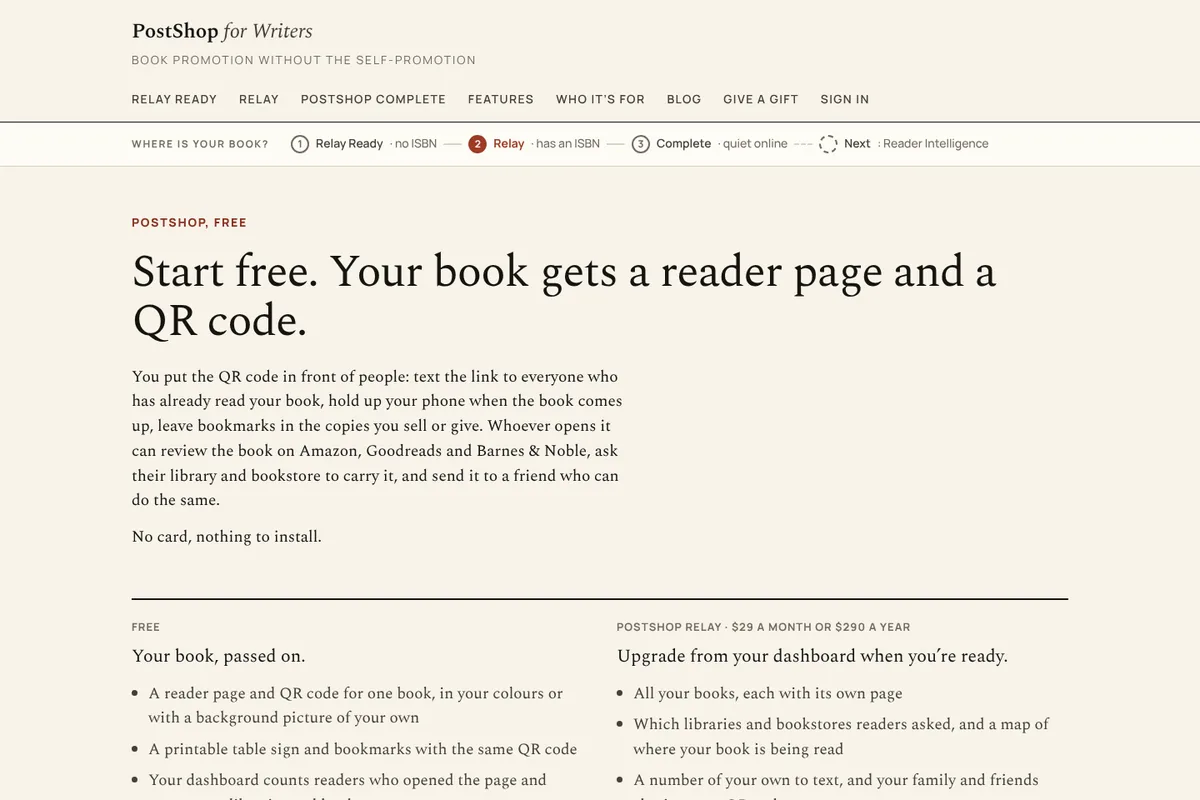
Free for one book. A reader page and QR code where readers review the book on Amazon, Goodreads or Barnes & Noble, ask a library or bookstore near them to carry it, and text the page to a friend, with a printable table sign and bookmarks. No card, nothing to install. Start free.
No ISBN yet? Relay Ready gives a book with no ISBN, or a single story, poem or essay, a free page to share with its first readers.
All your books: PostShop Relay, $29 a month or $290 a year, adds every book you have, which libraries and bookstores readers asked, and a map of where your books are being read.
Most promotion sites bring strangers to a book. The one that lasts is the readers who already loved it, with a way to pass it on.
More guides
References
- BookBub — “How the BookBub Featured Deal Selection Process Works.”
- Reedsy — “BookBub for Authors”: free to submit, paid if accepted, priced by genre and discount.
- BookBub — “Free Marketing Tools for Authors”: Author Profiles and New Release Alerts.
- LibraryThing — “Early Reviewers”: rules for offering books.
Figures and rules are cited as published by their sources. Where a source has updated them since, the source is authoritative and this page is not.