Guide · For writers
How to get book reviews without asking strangers.
Most reviews come from readers who already liked the book. The gap is the moment of asking, and how much effort it takes them.
The way to get more book reviews is to ask the readers who already liked the book, at the moment they finish it, and to make reviewing one step instead of ten. Most readers who enjoyed a book are willing. What stops them is the gap between meaning to and doing it.
Why reviews matter more for a small book
A reader deciding about a book they haven’t heard of has the cover, the description and the reviews, and the reviews are the only part the author didn’t write. They also move sales: economists comparing the same books on Amazon and Barnes & Noble found that when a book’s reviews improved on one site, its sales there rose relative to the other.1 In online shopping generally, products with five reviews were 270 per cent more likely to be bought than products with none.2 For a book with a handful of reviews, every one counts.
Why readers who liked your book don’t review it
It isn’t unwillingness. In one author’s survey of 93 readers, more than eight in ten said they would review more often if they knew how much it mattered.3 Three things get in the way:
- Nobody asked. Most readers don’t know what a review does for a book from a small press or a self-published author.
- Too many steps. Open the store, sign in, search for the book, find the right edition, scroll down, find the button, decide what to say. Each step is small; together they push it to later.
- Not sure what to write. Many readers think a review has to be an essay. A sentence or two is enough.
Ask the right people, in the right way
Ask readers in person, when they tell you they liked it. At a reading, a signing, a book club visit, or when a friend of a friend sends you a message about the book. That is the minute when a review is most likely to happen.
Hand them the link while the moment lasts. A promise to review “when I get home” is where reviews are lost. A QR code they can scan on the spot, or a link you text before they leave, turns the promise into the review.
Tell them it can be short. “An honest sentence or two helps other readers find it” removes the hardest part.
Ask for honesty, not stars. Ask for an honest review, never a good one. It is the right thing to do, and it is also what the stores require.
Know the rules
Amazon doesn’t allow reviews from people who share a household with the author or from the author’s close friends, and it removes reviews it judges to come from someone the author knows.4 So don’t ask your family for Amazon reviews, and never offer anything in return for a review. Readers you don’t know personally, who bought or borrowed the book and liked it, are the reviewers who count.
Goodreads and Barnes & Noble are worth asking for too. Goodreads is where many readers keep track of what they read, and before a book is out, readers with an advance copy can review it there.
Advance copies, for reviews at launch
If the book isn’t out yet, advance copies to readers in your genre can put reviews in place by launch day. LibraryThing’s Early Reviewers program matches authors and publishers with readers who request advance copies; it is free, and an author or publicist can offer between 5 and 30 paper copies, or 5 to 10 ebook or audiobook copies, in a giveaway.5
Make it one step
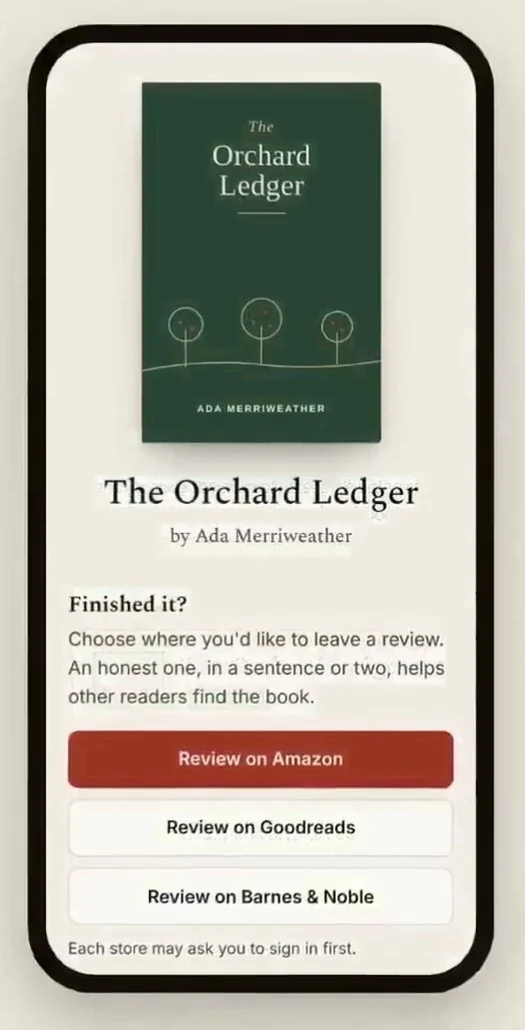
The single biggest change is to replace “go to Amazon and find my book” with one link that opens a page where every review button is already there. Print it as a QR code on the last page of the book and on bookmarks, and text it to readers who tell you they enjoyed it. Our guide to QR codes for books covers where to print it and how big.
Quick answers
Can my family review my book on Amazon? No. Amazon doesn’t allow reviews from people in the author’s household or from close friends.4 Family can still tell people about the book and ask their library to carry it.
Can I give someone a free copy and ask for a review? You can give copies, as long as you ask for an honest review and make clear that any opinion is welcome. Never make a review, or a good one, a condition.6
How many reviews does a book need? There is no official number. BookBub, for example, has no minimum review requirement for its Featured Deals, though it notes that readers are more likely to buy well-reviewed books.7 The first few reviews do the most work.
How PostShop does this
We run Silent Clamor Press, and we built PostShop Relay for this step.
Every review button on one page. Each book gets a reader page and a QR code. A reader scans it and can review the book on Amazon, Goodreads or Barnes & Noble from one place, with a line reminding them that an honest sentence or two helps. Before launch, readers with an advance copy can review it on Goodreads from the same page.
A reminder for readers who haven’t finished. A reader who is partway through can set a reminder from the page, so the review isn’t lost to later.
More than reviews. From the same page, readers can ask their library or a bookstore near them to carry the book, and text the page to a friend.
You see what happened. Your dashboard counts the readers who opened the page and the requests they sent to libraries and bookstores. Relay is free for one book. See how it works, or start free.
Most books don’t lack readers who liked them. They lack a way for those readers to say so in the minute they mean to.
More guides
References
- Judith A. Chevalier and Dina Mayzlin — “The Effect of Word of Mouth on Sales: Online Book Reviews,” Journal of Marketing Research 43, no. 3 (2006).
- Spiegel Research Center, Northwestern University — “How Online Reviews Influence Sales.”
- Mateja Klaric — survey of 93 readers on why they rarely leave book reviews; a small sample from one author’s readership.
- TCK Publishing — on Amazon’s customer review guidelines for books, quoting Amazon: people who share a household with the author, and close friends, may not write reviews of the author’s book. Amazon’s own guidelines are authoritative.
- LibraryThing — “Early Reviewers”: rules for offering books; the program is free.
- Author Imprints — “Amazon Book Review Policy Demystified for Authors”: free copies are allowed when all feedback, positive and negative, is welcome.
- BookBub — “How the BookBub Featured Deal Selection Process Works”: no minimum review requirement.
Figures and rules are cited as published by their sources. Where a source has updated them since, the source is authoritative and this page is not.