Guide · For writers
How to find beta readers, and what to send them.
The best beta readers are usually one step from you. What you send them decides what you get back.
Most writers find their best beta readers one step away: people in a writing group or class, readers they already know, and the friends those readers pass the draft to. What decides how useful they are is less where you find them than what you send: a clear pitch, the right amount of the manuscript, and a few specific questions.
What beta readers do
A beta reader reads a draft that is close to finished and tells you how it reads to someone who isn’t a writer: where they were gripped, where they got lost, where they stopped. That is different from two other kinds of early reader. Alpha readers see a rougher draft, usually someone close to you. ARC readers get an advance copy of the finished book, and their job is a public review at launch, not changes to the text. Unlike a beta reader, an ARC reader isn’t there to suggest changes or point out plot holes.1
So a beta reader’s value is a reader’s reaction, written to you privately, while you can still revise.
Where to find beta readers
Start one step from you. Your writing group, workshop or class, a writing friend whose taste you trust, and readers you know who read in your genre. Then ask each of them who else should see it. The friend of a friend who reads three thrillers a month gives you a stranger’s reaction without a stranger’s indifference.
Ask for the readers your book is for. Five readers of literary fiction will tell you more about a literary novel than twenty general readers. Two or three who don’t usually read your genre are useful too, as a check on whether the opening works for anyone.
Paid and swap options. Some writers pay professional beta readers or trade reads with other writers. Both can work. Paid readers are reliable about deadlines; swaps get you a writer’s eye rather than a reader’s. Neither replaces readers who would actually buy the book.
How many. Enough that one person’s taste doesn’t decide anything. When three readers stop in the same chapter, that is a finding. When one does, it may be the reader.
What to send them
A one-sentence pitch. It tells the reader what kind of book this is before they start, and it lets you see whether the pitch makes the right people want to read it.
The right amount of the book. For a first round, an opening of a few chapters is often enough to learn whether the book holds a reader. Send the full manuscript to the readers who ask for more; their asking is part of the answer.
Three questions, no more. Where did you stop wanting to read, if anywhere? What did you expect to happen that didn’t? Who would you give this book to? Specific questions get specific answers. “What did you think?” gets “I liked it.”
A date and a thank-you. Say when you would like to hear back, and how you will thank them: their name in the acknowledgements, an early copy, or simply telling them what you changed because of what they said.
Short stories, poems and essays
A single piece needs one more precaution. Many literary journals consider work that has appeared online, including on a personal website or social media, to be previously published, and won’t take it.2 One journal’s guidelines, for example, say that work that has appeared anywhere online counts as previously published.3 An excerpt is generally treated differently, as long as it is short relative to the whole piece.4 So for a piece you plan to submit, share a part of it, or send it privately, and check the guidelines of the journals on your list first. Once a journal has published it, that worry is gone, and the readers you send it to can read it there.
Keep it moving
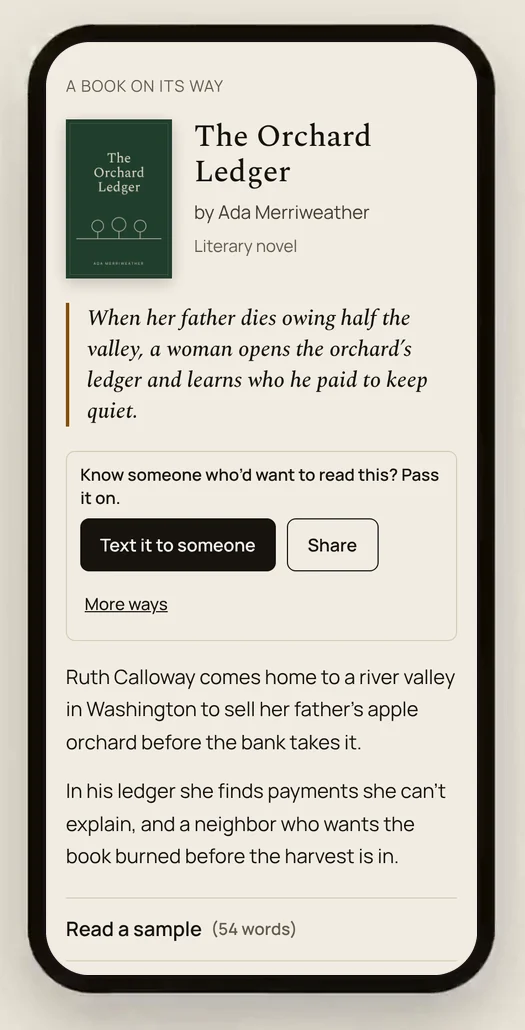
The usual way to share a draft is an attachment in an email. It reaches the people you send it to and stops there. A single page with your pitch, a sample and a way to reach you is easier to pass on: a reader who likes the opening can send the link to the friend they had in mind, and you hear from people you would never have known to ask.
Quick answers
How many beta readers do I need? Enough that no single reader’s taste decides anything. Five to ten is a workable number for a novel; three or four is plenty for a single story, poem or essay.
When should I send to beta readers? After you have revised it as far as you can on your own, and before a copyedit. Their notes may change whole scenes, so there is no point polishing sentences first.
Are beta readers the same as ARC readers? No. Beta readers give you private notes while you can still change the book. ARC readers get a finished advance copy and write public reviews at launch.1
Should I pay beta readers? You don’t have to. Readers you know are free and often more honest about whether they would pick up the book. Paid readers are useful when you need a deadline met or a genre specialist.
How PostShop does this
We run Silent Clamor Press, and we built Relay Ready for books and pieces that need their first readers.
A page for the writing, free. Your book with no ISBN yet, or a single story, poem or essay, gets a page with its one-sentence pitch, a few lines about it, an optional sample (for a single piece, up to 30% of it), a cover or a photo of you, and your own contact link. It also says what you would welcome from readers, such as beta readers or feedback on the draft, in your voice.
Easy to pass on. The page has its own link and QR code. Anyone who opens it can text it to someone, copy the link or show the QR code. Readers who want more get in touch with you, and you decide who gets the rest.
You see how far it went. The free page shows how many people opened it, and how many came from someone else’s link. Paid Relay Ready, $14.99 a month, adds a map of where it is being read and how many steps out from you it has travelled, messages from readers through the page, and a pitch test that shows which version of your pitch more readers act on.
Search engines don’t list it. The page asks search engines not to index it, and it is seen by the people it is passed to. When the book is published, the same link and QR code open its reader page.
See how Relay Ready works, or give your writing a page, free.
The best beta readers are rarely strangers on a forum. They are the readers you already know, and the readers they know.
More guides
References
- Draft2Digital — “Beta Readers vs. ARC Readers: What’s the Difference?”
- Purdue Online Writing Lab — “Submitting to Literary Magazines”: a piece posted on a blog, website or social media is almost always not eligible.
- American Literary Review — submission guidelines: work that has appeared anywhere online counts as previously published.
- Writer’s Relief — on previously published work: short excerpts posted online are generally acceptable.
Figures and rules are cited as published by their sources. Where a source has updated them since, the source is authoritative and this page is not.