Guide · For writers
How to get your book into libraries: why reader requests work.
Libraries buy what their cardholders ask for. A request from a local reader carries more weight than a pitch from the author.
The most reliable way to get a book into a public library is for the library’s own cardholders to ask for it. Libraries buy what their patrons request, and a request from a local reader carries more weight than a pitch from the author. Your job is to make that request easy for readers in as many towns as possible.
How libraries decide what to buy
Each library system has a collection budget and someone who chooses what to buy with it. They work from a few sources. One public library lists positive reviews in professional sources, the author’s credentials, community interest, cost, and whether the book can be bought through the library’s contracted vendors.1 Larger systems lean toward popular titles from known publishers, and some won’t act on a suggestion for a book more than two or three months from publication.2
For a book from a small press or a self-published author, two of those sources matter most: reviews and patron requests. Librarians interviewed by the Independent Book Publishers Association said they take patron requests seriously, and one said that, with a shrinking budget, they buy only from reviews or patron requests.3 A public library director put it the same way: libraries track their patrons’ requests to decide what to buy, and how many copies.4
Why a request beats a pitch
When an author emails a library, the librarian hears from one person with an obvious interest in the answer. When five cardholders ask for the same book, the library hears its public telling it what they want to read. That is the evidence a selector is looking for, and it is something only readers can provide.
The purchase-suggestion form, and why few readers use it
Almost every public library has a way for cardholders to suggest a purchase, usually a form on its website that asks for the title, author, ISBN and the reader’s card number. A librarian decides whether to buy it and replies to the reader.5
Few readers know the form exists, and fewer go looking for it. To use it, a reader has to find the library’s website, find the form (often several clicks deep), and type in the book’s details. A reader who loved your book and would happily ask usually never gets that far.
What you can do as the author
- Make the book easy to order. Libraries buy through wholesalers such as Ingram and Baker & Taylor. Check that your book is listed with them, with the correct ISBN, price and description.
- Get reviews. Reader reviews help a selector judge a book they haven’t seen. Our guide to getting book reviews covers how.
- Ask your own library, once. Introduce yourself, leave a copy if they accept donations, and offer a reading. Many libraries consider donated copies under their collection policies.6
- Then ask your readers to ask theirs. This is where most of the reach is. Every reader who asks their library puts the book in front of a selector in a town you have never visited, and a book on one library’s shelf is in front of every cardholder who walks past it.
Bookstores work the same way
An independent bookstore stocks what it expects to sell in that store, and a customer asking to order a copy is one of the clearest signs it can get. A request from a local customer counts for more than a call from the author for the same reason a cardholder’s request does.
Quick answers
Do libraries buy self-published books? Many do, when cardholders ask for them, the book has reviews, and it can be ordered through the library’s usual vendors.1 Some larger systems focus on popular titles from known publishers,2 which makes reader requests even more important.
When should readers ask? Close to publication or after it. Some libraries decline suggestions for books that are more than two or three months from publication.2
Should I send free copies to libraries? Offer one to your own library. Many consider donations under their collection policies,6 but mailing copies to libraries you have no connection with rarely helps.
How PostShop does this
We run Silent Clamor Press, and we built PostShop Relay because our own authors kept hitting this wall.
The request page of the reader’s own library. Each book gets a reader page and a QR code. A reader scans it and sees the libraries near them, not near you, chooses one where they have a card, and goes straight to that library’s request page. The library lists cover the United States.
Bookstores near the reader. From the same page, a reader can ask independent bookstores near them to carry the book.
Passed on, town to town. The reader can text the page to a friend, and it works for the friend where they live. That is how a request reaches a library you would never have thought to contact.
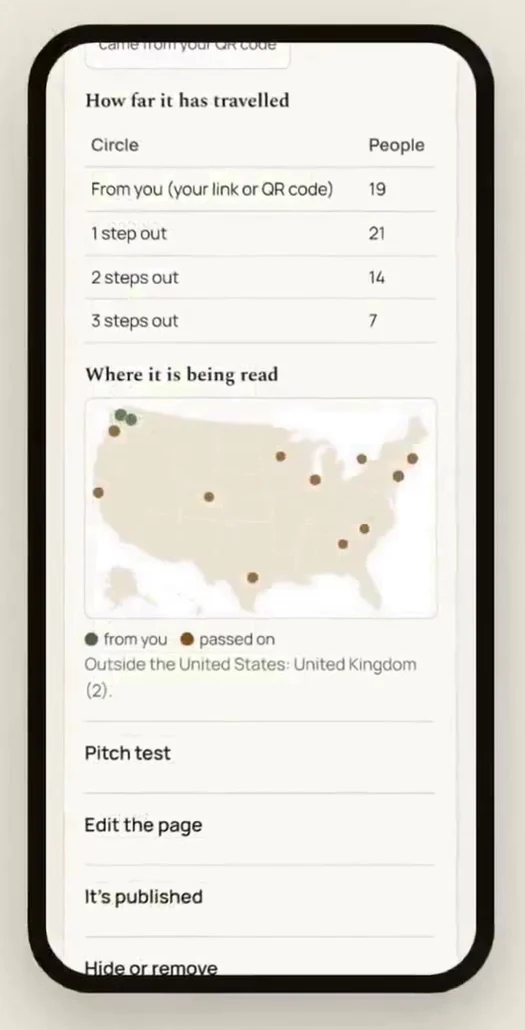
You see where readers asked. The free plan counts the requests. Paid Relay names each library and bookstore readers went to, and shows them on a map. When several readers have asked the same bookstore, you know where to walk in with a copy and introduce yourself.
Relay is free for one book. See how it works, or start free.
A library will rarely buy a book because its author asked. It often will when its own readers do.
More guides
References
- Cambridge Public Library — “Suggest a Purchase”: the factors its staff weigh in purchase decisions.
- Wake County Public Libraries — “Why was the book I suggested for purchase declined or not selected?”
- IBPA — “Getting Librarians to Buy Your Books”: librarians on reviews and patron requests.
- Writers’ Rumpus — interview with public library director Noelle Boc on collection development.
- Santa Barbara Public Library — “SBPL’s Guide to Suggesting Books and DVDs for Purchase.”
- Abigail Goben, Writer Beware — “How Libraries Choose Books to Purchase”: a public librarian on donations and collection policies.
Figures and rules are cited as published by their sources. Where a source has updated them since, the source is authoritative and this page is not.